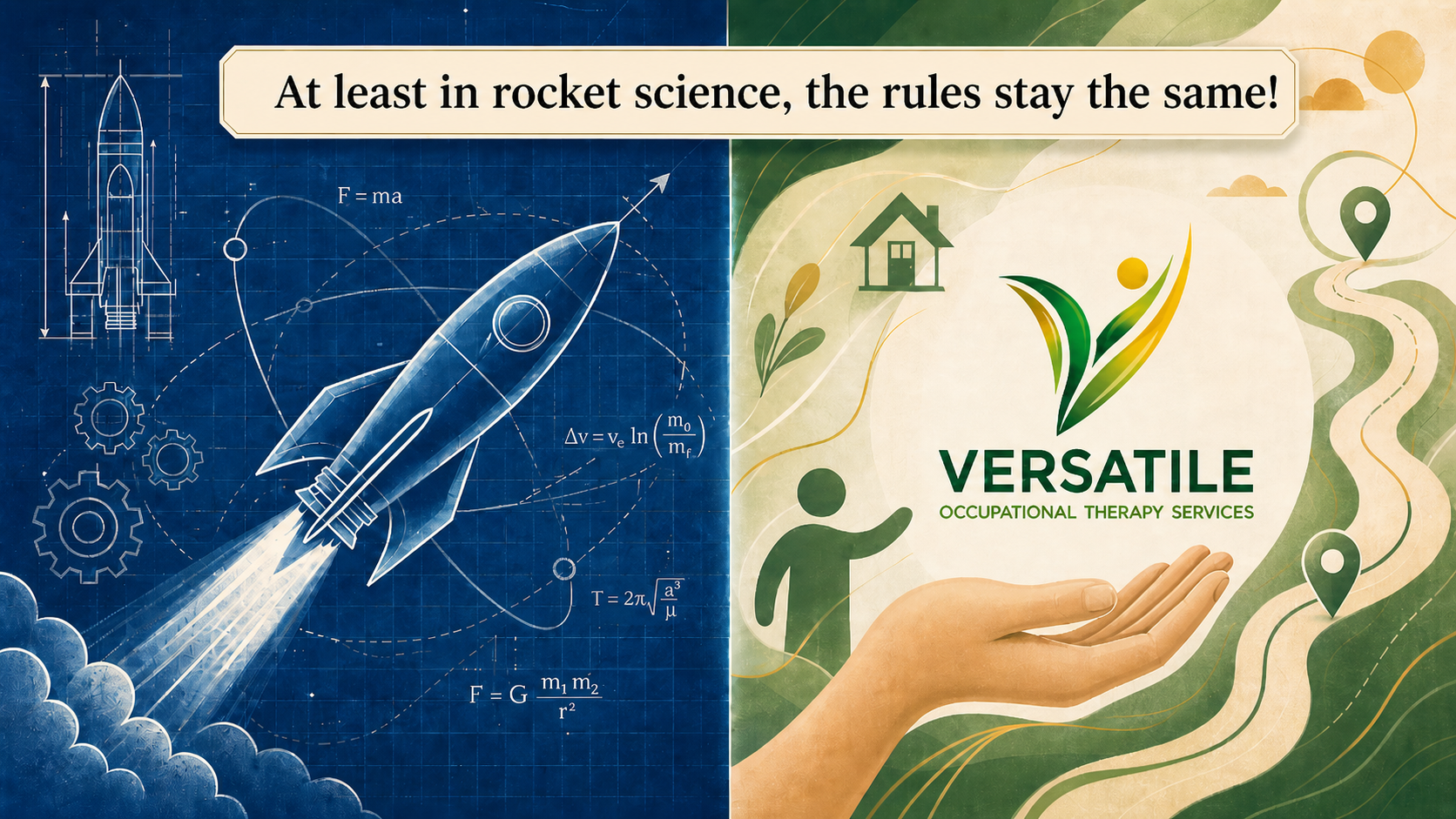
The Launch: Why Standing Up IsA Bit Like Rocket Science
It’s a tongue-in-cheek comment often heard in high-stakes environments, but in occupational therapy it carries a quiet truth.
Rocket science is built on stable foundations. Gravity behaves predictably. Equations, once proven, remain consistent and universal. There is a logic to launch: a set of calculations, checks and conditions that must align before lift-off.
Occupational Therapy helps bridge the gap between what may feel like a different reality and practical, achieveable steps towards independence.
The physics of the first stand.
Consider a client who has spent months bedbound in hospital. For them, the simple act of standing may represent something far greater than a transfer. It may be their version of a moon landing.
From the outside, the task can look straightforward. The equipment is available. The technique is known. The transfer aid is in place. The plan appears simple:
The right equipment + the right procedure = the right result
But the occupational therapist knows, our clients do not work like equations.
In a rocket launch, gravity does not lose confidence halfway through. The fuel does not have an off-day. The calculations do not become anxious.
A client may be more fatigued than yesterday. Pain may increase. Confidence may be lower. The bed may be slightly too high. The space (within the room) may be cluttered. There may have been a poor night’s sleep or a moment of fear can alter a session.
What worked yesterday may not work today.
That is not failure. That is reality. More than a calculation.
Occupational therapy is not about abandoning structure. Far from it. We use frameworks, evidence, clinical reasoning, moving and handling principles, equipment knowledge and risk assessment. These are our ground control.
But they are guides, not guarantees.
The skill lies in interpretation. Reading the person, the task and the environment. Knowing when to continue, when to pause, when to adapt, and when to stop.
A sit-to-stand transfer is not just a movement from one surface to another (such as from bed to a chair). It is confidence, timing, trust, fatigue, fear, strength, dignity and carefully managed risk all happening at once.
Perhaps that is why the rocket science comparison stays with us.
Not because standing from a bed is technically harder than orbital mechanics, but because it asks for something less neat and more human.
It requires judgement. Adaptation. Patience. And the ability to hold uncertainty without reducing the person to a process.
When a client finally stands after months in bed, supported by the right equipment and the right approach, it is a triumph of physics.
But more than that, it is a triumph of confidence, courage and clinical care working together.
It is not just a transfer. It is a moment of progress, trust and clinical judgement. And ultimately, it is deeply human.