
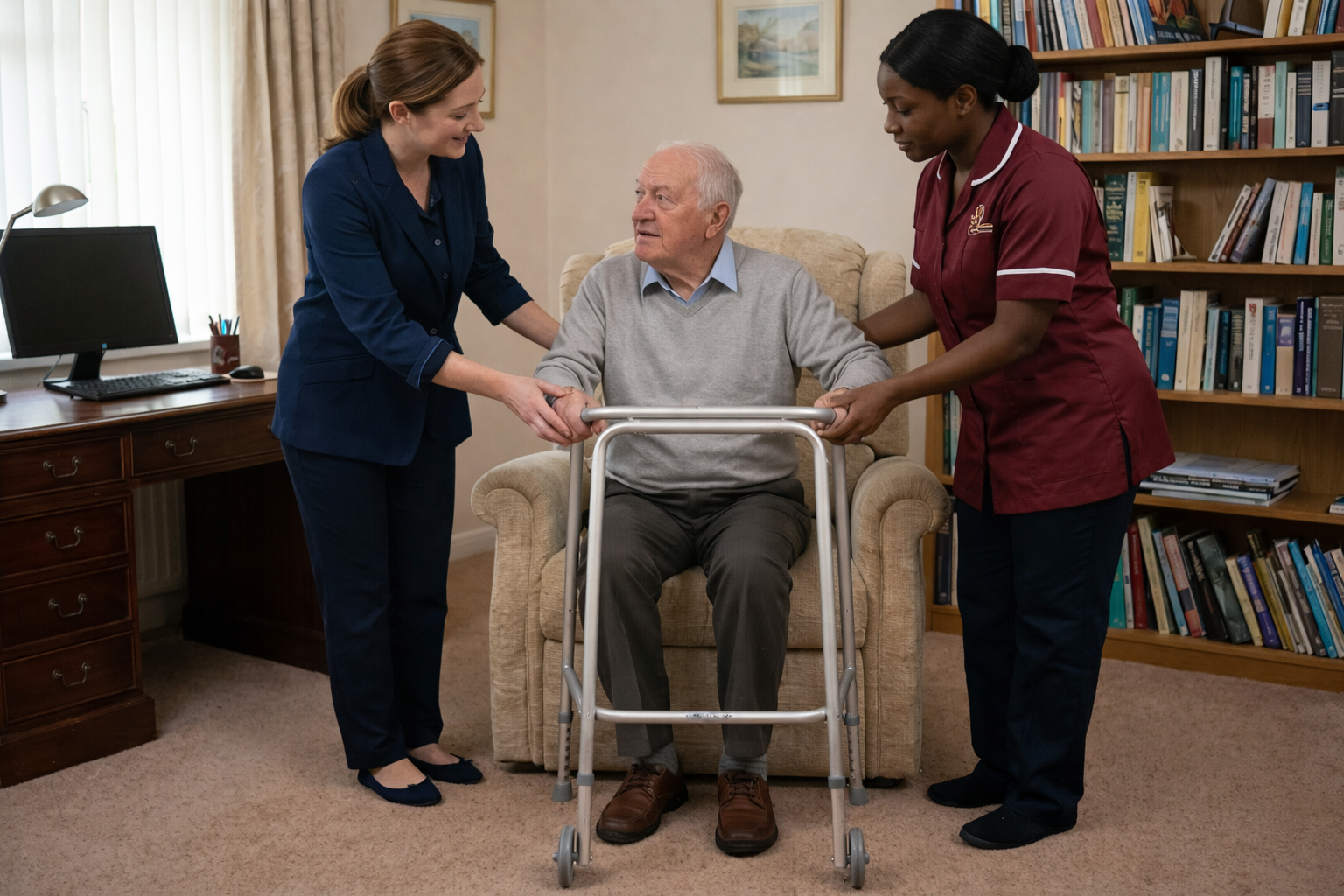
Specialist Moving and Handling Assessments
Improving your safety and comfort at home
Clear, practical and evidence-based moving and handling guidance
Who this service is for
We provide moving and handling assessments for:
✓ Individuals living at home
✓ Family members and informal carers
✓ Case managers and local authorities
✓ Care agencies and support providers
✓ Organisations commissioning or reviewing care
Our specialist moving and handling assessments are for anyone who requires support with transfers and mobility, and for those involved in their care.
When we say moving and handling, we’re referring to how a person moves safely and comfortably during everyday activities. This may include getting in and out of bed, standing up from a chair or moving between places such as the bed, chair, wheelchair or toilet.
As occupational therapists, we frequently support people who leave hospital with their medical needs addressed, but who find that standing up, transferring, or moving safely is suddenly much harder than before. A moving and handling assessment can help bridge this gap, supporting recovery while keeping safety and dignity at the centre of care.
What the assessment includes
Our assessment focuses on understanding what the individual is finding difficult, why it is happening and what support or equipment may help them and those providing assistance.
The assessments we provide typically include:
✓ Observation of current moving and handling practice
✓ Hoisting and equipment assessments, including sling selection (where appropriate)
✓ Identification and reduction of risk for both the individual and those supporting them
✓ Development of clear, well-structured handling plans and risk assessments where required
✓ Assessment of functional transfers, such as getting in and out of bed, standing up from a chair and transfers to the toilet or wheelchair
✓ Postural positioning and stability considerations
✓ Practical demonstration and guidance for carers, including safe use of recommended equipment
✓ Recommendations regarding the appropriate level of support from carers
All of our recommendations are tailored to the individual’s needs, environment and available support.
How do I know if I need this?
If you or a family member is spending long periods of time in bed or in a chair, or requires physical assistance, or is being supported using equipment such as a hoist or transfer aid, this assessment will be relevant.
Is bed rest always helpful?

Until relatively recently, bed rest was often seen as an important part of recovery and in some situations, rest is absolutely necessary.
However, we now understand that periods of reduced movement or prolonged bed rest can lead to a rapid loss of strength, balance and confidence with everyday movement.
As occupational therapists, we frequently support people who leave hospital with their medical needs addressed, but who find that standing up, transferring or moving safely is suddenly much harder than before. A moving and handling assessment can help bridge this gap, supporting recovery while keeping safety and dignity at the centre of care.
How to get started with an assessment
We provide a clear, four-step journey to ensure your home modification is a success.
1
Initial discussion
You can arrange to have a brief conversation with us so you can explain your situation and we can confirm that a moving and handling assessment is appropriate.
2
Assessment
This will be completed in the individual’s home to ensure a realistic understanding of transfers, equipment use and risk.
3
Recommendations
We will then come back with clear, practical guidance tailored to the individual, their environment and those providing support. Any equipment or techniques will be demonstrated with caregivers where appropriate.
4
Report
A moving and handling plan and risk assessment will be prepared, tailored to the individual’s needs and circumstances. The reports are written to be clear, structured and practical, suitable for sharing with care providers and commissioning teams.
Book a free call to discuss your moving and handling assessment
If you would like to discuss whether a Specialist Moving and Handling Assessment would be beneficial, please call us (you can request a callback), email us, or complete the contact form to arrange a free, 15-minute consultation.
Frequently Asked Questions
-
Assessments are completed in your own home, so we can understand your environment and how daily transfers are managed in practice.
We observe how you move between everyday positions, such as getting in and out of bed or standing up from a chair, and identify any risks to you or those supporting you.
The focus is on understanding what is difficult, why it is happening and what practical changes — such as equipment, techniques or levels of support — may improve safety and comfort.
-
Yes. We regularly review existing equipment as part of the assessment.
In many cases, small adjustments or alternative equipment can make a significant difference to safety, comfort and ease of handling.
Where new or different equipment is recommended, we provide clear guidance, so you and/or your family can make informed decisions.
-
Yes. Moving and handling assessments consider the safety of everyone involved.
By identifying risks and recommending appropriate techniques, equipment and levels of support, our input can help reduce strain and injury for carers and family members assisting with transfers.
Equipment recommendations are made with practicality in mind, with responsibility for purchasing remaining with you and/or your family, unless alternative arrangements are already in place.
-
Decisions about carer numbers should always be based on individual assessment rather than assumption.
While it is often assumed that two carers are required for tasks such as hoisting, this is not always the case. With the right equipment, environment and risk assessment, it can often be safe and more appropriate for just one carer to assist.
We have extensive experience of reviewing care arrangements and frequently identify situations where care can be delivered safely with fewer carers, without compromising anyone’s safety or dignity.
All recommendations are based on clear clinical reasoning. Where appropriate, this approach can also help reduce unnecessary care provision.
-
Yes. We can demonstrate recommended techniques and equipment with carers and care agencies to support safe, consistent practice.
This helps to ensure that everyone involved understands the agreed approach and feels confident in the day-to-day care they are receiving or providing.