

Specialist Seating & Postural Management

Expert assessment and seating recommendations to support comfort, safety and independence.
At Versatile, we provide specialist seating and postural management assessments for adults whose current seating does not adequately support their comfort, safety or daily function.
This service is most often requested following hospital discharge, changes in mobility, or where sitting, transfers or comfort in the chair have become unsafe, difficult or poorly supported.
Seating is sometimes treated as furniture. Clinically, it is not.
The right chair can determine whether someone is able to sit out of bed, transfer safely, participate in daily life and maintain their independence. The wrong chair can contribute to pain, pressure damage, falls, fatigue and increasing reliance on care.
A significant proportion of people with complex physical needs are using seating that does not properly match their body shape, postural needs or functional abilities. This is particularly common following hospital discharge or changes in health.
Our assessments focus on understanding how a person sits in practice, how their body is supported, and how seating affects comfort, safety, transfers and day-to-day function.

Is seating really that important?
Many people gradually spend more time in bed because their chair is uncomfortable, unstable or difficult to transfer into.
Over time, this can lead to:
Rapid loss of muscle strength
Reduced balance and confidence
Increased falls risk
Pressure sore risk
Greater reliance on carers
Appropriate seating can reverse this trajectory by enabling safe sitting, supported posture and more regular movement throughout the day.
In many cases, it becomes the foundation for maintaining mobility and independence at home.
What our seating assessments include
Review of current seating and equipment
Observation of sitting posture and positioning
Assessment of pelvic position, trunk support and head control
Evaluation of seat width, depth, height and back support
Consideration of pressure risk and skin integrity
Assessment of the ability to stand, transfer and reposition
Recommendations for specialist seating, such as riser recliners, tilt-in-space chairs and bespoke seating systems
Integration with moving and handling recommendations where relevant
All recommendations are tailored to the individual’s body shape, condition, environment and daily routines.

Seating, independence and quality of life
Appropriate seating can be the difference between someone becoming largely bed-bound and being able to sit out comfortably, move around the home, and continue taking part in everyday life.
When the right seating is in place, posture, comfort and stability are better supported. People often report feeling more alert, more independent and more connected to daily life. For many, it also makes everyday activities such as eating, drinking, and getting in and out of the chair safer and easier.
Families often tell us that being able to sit out — even for short periods at first — makes a significant difference to mood, confidence and overall well-being.
For many people, specialist seating can be genuinely beneficial to quality of life. Being properly supported in a chair can reduce discomfort, ease fatigue, and allow someone to spend meaningful time out of bed. By contrast, the wrong chair can be extremely uncomfortable and, over time, reduce activity, confidence and overall quality of life.
For this reason, we place significant emphasis on seating assessments. Small changes in posture, positioning or equipment can make a substantial difference to comfort, safety and day-to-day function.

Who benefits from specialist seating
Adults living at home with health conditions affecting comfort, posture or mobility
People experiencing pain, fatigue, falls, or reduced confidence when sitting
Individuals spending long periods in bed, or who struggle to maintain an upright and stable posture in their current chair
People whose mobility or balance has changed following illness, injury or hospital admission
Individuals who have recently started using equipment such as a hoist, stand-aid or wheelchair, or whose current chair no longer provides the support they need
Why time in bed changes everything
When someone is confined to bed muscle strength can decline rapidly often by as much as 3% per day. Over the course of even a shorter hospital admission this could result in a significant loss of muscle strength. In practice this can be the difference between a person being able to stand from the bed independently and requiring physical assistance or hoisting to transfer safely.
As clinicians we often see this issue: medical treatment addresses the immediate illness, but physical capacity and confidence can deteriorate quickly when movement is limited.
This is one of the reasons early sitting out of bed and having appropriate seating are so important.
The manual handling triad
At home, safe mobility depends on how three key elements work together, rather than on any one item of equipment alone:
• The bed (often an adjustable profiling bed)
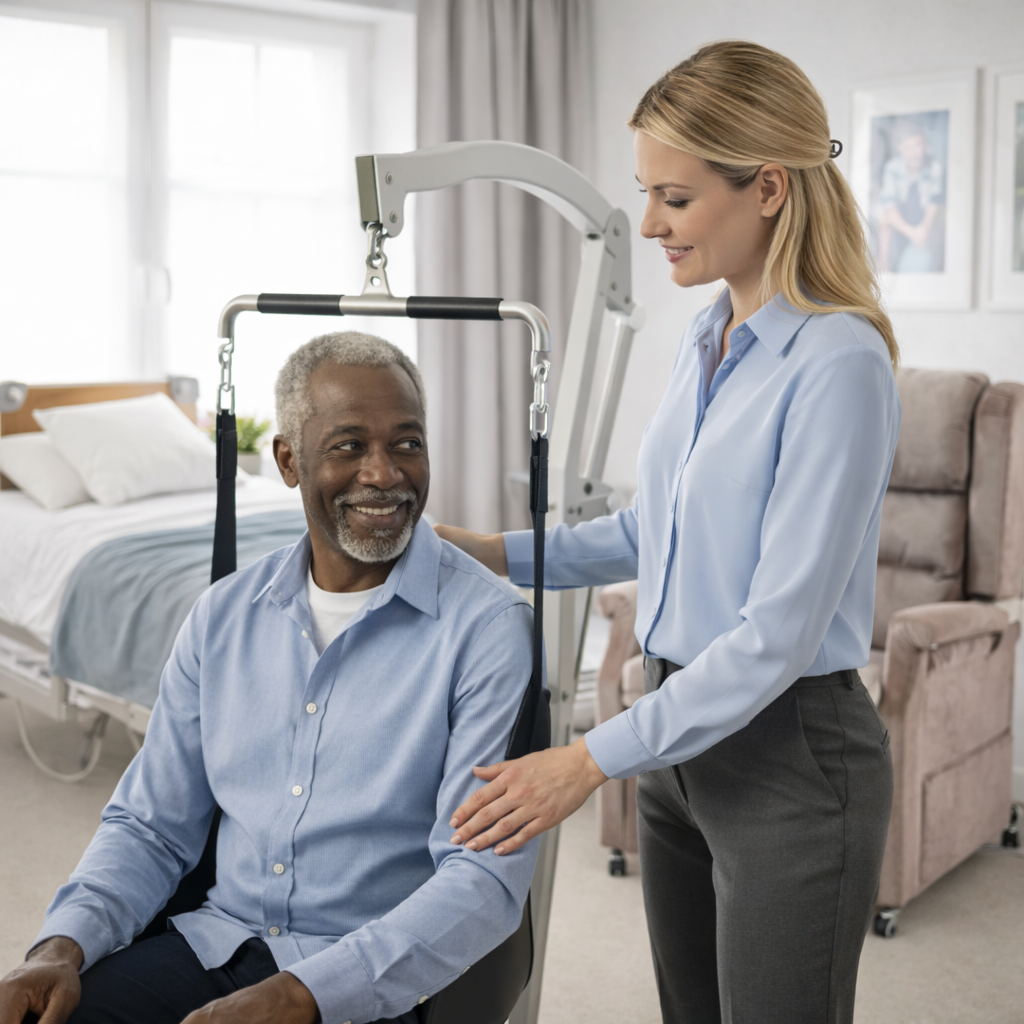
• The transfer method or equipment (such as a hoist or stand-aid)
• The seating used during the day
When these three are in-place people are more likely to sit out, move regularly and retain functional ability.
When one element is overlooked, the whole system becomes less effective.
In our experience, seating is the most frequently neglected part of this triad, despite often being the factor that determines whether someone spends their day in bed or out in their living space.
Seating as part of recovery
Seating is often viewed as something passive such as a place to rest. Clinically, it plays a much more active role.
Appropriate seating supports upright posture, controlled movement and regular changes in position. This allows people to engage their muscles, tolerate sitting for longer periods, and potentially gradually rebuild strength and confidence following illness or hospital admission.
In contrast, poorly fitting or unsupportive seating can accelerate fatigue, discourage movement and reinforce dependence on bed-based care.
For this reason, we view specialist seating as part of the rehabilitation process, not simply as an item of furniture. When chosen and set up correctly, it can help interrupt the cycle of deconditioning and support a safer return to everyday activity.
How we work

Initial discussion
A brief conversation to understand concerns and confirm this assessment is appropriate.

Assessment
Completed in the individual’s home to observe real-world daily activities.

Recommendations
Clear, practical guidance tailored to the individual and their environment.

Follow-up
Further input can be arranged to review progress or provide more specialist assessment if needed.
Not sure where to start?
Free 15-Minute Consultation
We offer an initial telephone consultation at no cost to you. This is an opportunity to:
Discuss your situation in confidence
Ask questions and explore options
Understand whether our service is the right fit
Our Promise:
No obligation. No hard selling. Just honest guidance. Even if we aren't the right fit, we are happy to provide signposting or advice to help you find what you need.
Frequently Asked Questions
-
A chair may look suitable at first glance, but the key question is whether it properly supports the person’s posture, comfort, safety and ability to function throughout the day.
Signs that specialist seating may be needed include difficulty sitting out for any length of time, sliding or leaning in the chair, discomfort, fatigue, poor posture, increased time spent in bed, or difficulty transferring safely in and out of the chair.
In some cases, a more suitable standard chair is enough. In others, specialist seating is needed to provide the right level of support and reduce the risk of pain, pressure damage, falls and increasing dependence on care.
A seating assessment helps identify what is actually needed, based on the individual rather than the furniture.
Our approach is impartial and clinically led. We will only recommend specialist seating where it is genuinely necessary, and where it is likely to improve comfort, safety, posture, or long-term well being.
-
Yes. Many families feel unsure where to start, especially when needs have changed suddenly after illness or a hospital stay. We take time to understand the person’s comfort, posture, daily routines and what matters most to them, and then explain the options clearly so you can make decisions with confidence.
-
In some situations, appropriate seating can enable safer independent transfers or reduce the level of physical assistance required.
-
No. We remain independent of manufacturers and suppliers. Our role is to provide clear, objective clinical recommendations so that with guidance individuals and families can source seating with confidence, knowing it is appropriate for their needs.